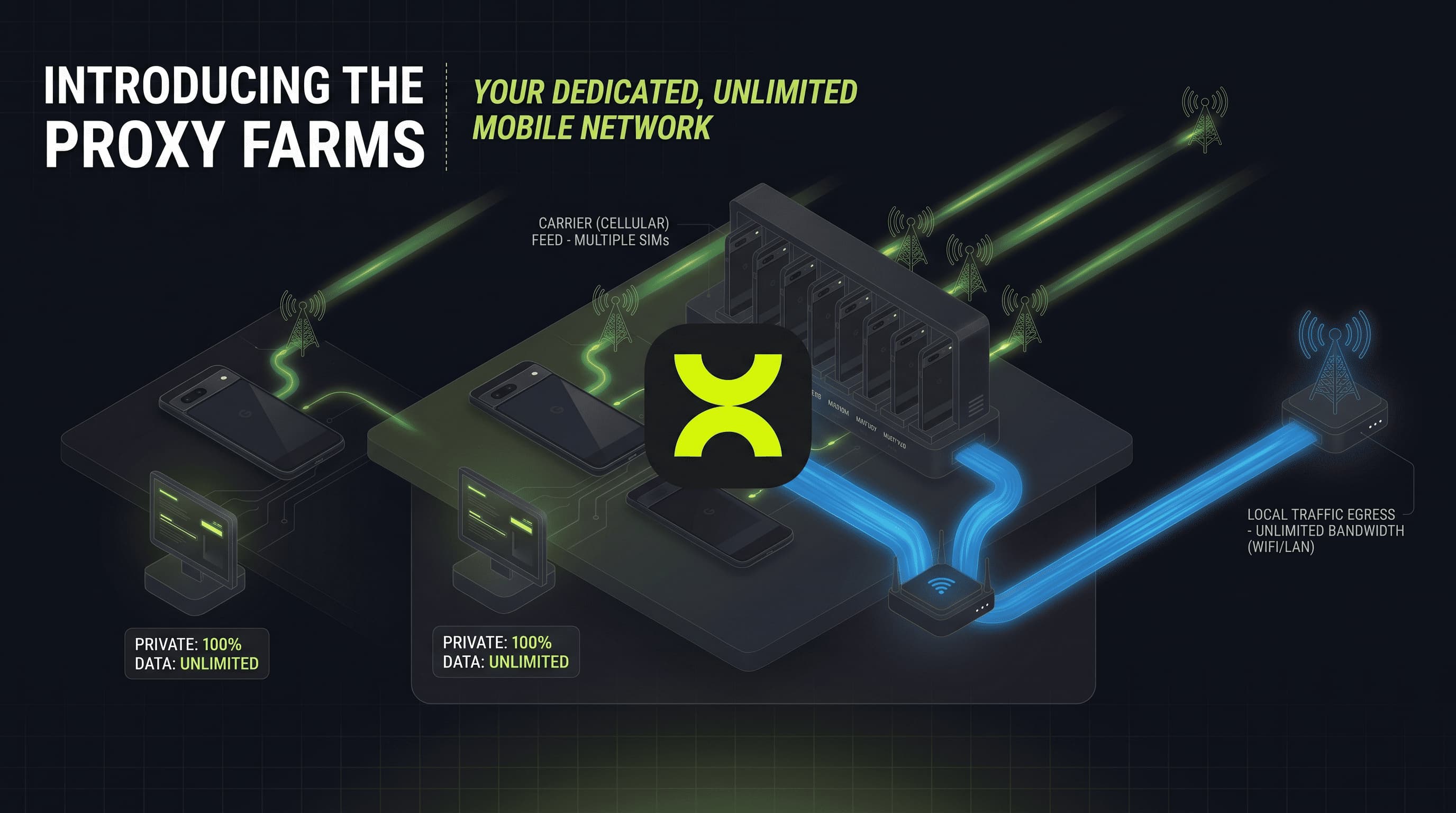
Optimizing Proxy Speed and Slashing Data Overhead with Turbo mode
Maximize mobile proxy speed and slash cellular data usage. Learn how asymmetric routing fetches requests via 4G/5G SIMs and routes payloads over high-speed WiFi.
When you’re running high-throughput web scraping, programmatic ad verification, or mobile app QA, IP reputation is everything. That’s why engineers are migrating away from shared residential proxy pools to dedicated mobile hardware.
But running your own fleet of Android devices introduces a new bottleneck: cellular bandwidth and latency.
If you route your entire proxy infrastructure through the cloud and back down to a mobile device over a 4G/5G connection, you are effectively paying the "latency tax" twice. Every megabyte of data downloaded from the target server must be transmitted back to your scraper over that same cellular network.
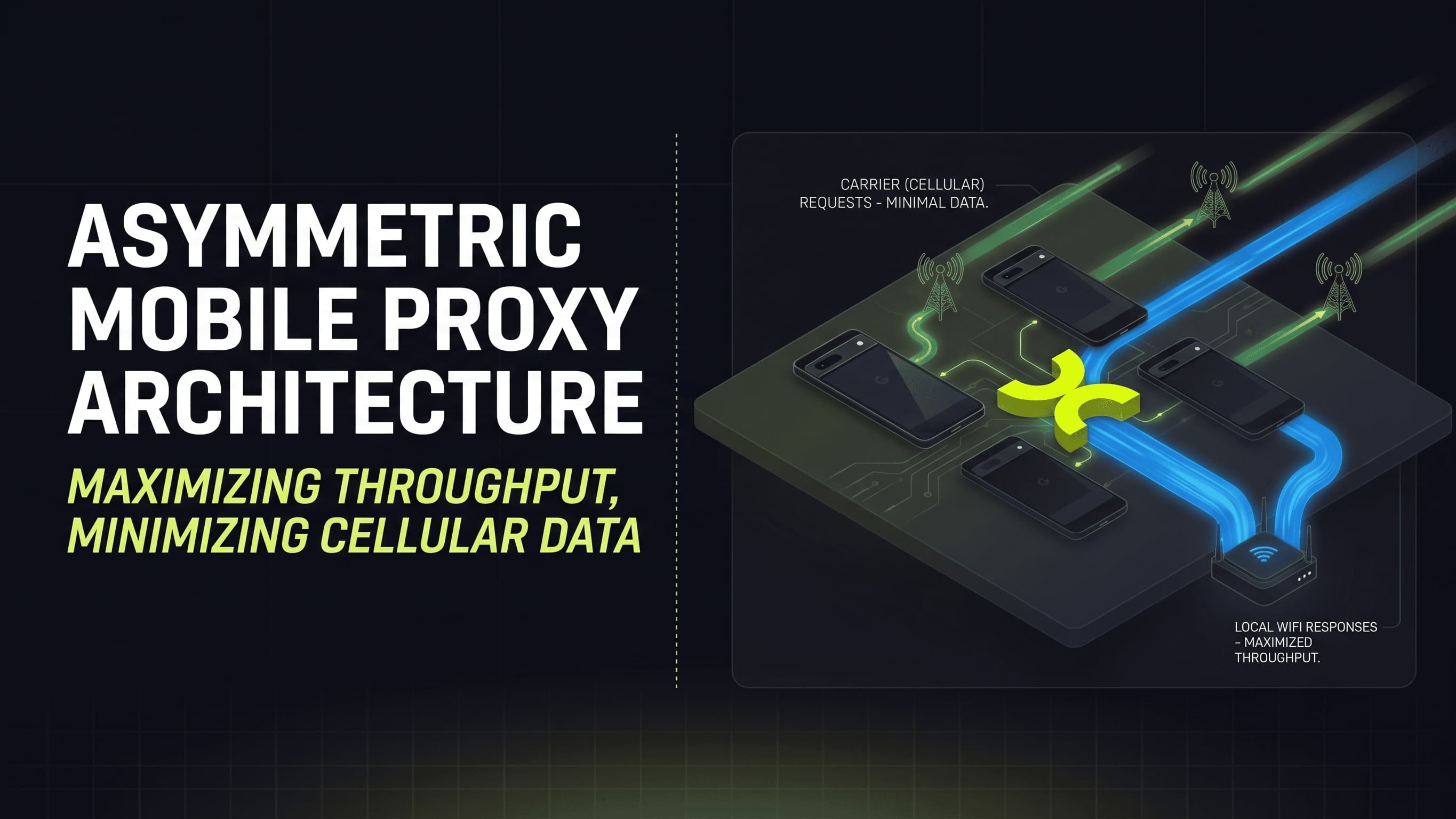
At Proxy Farms, we solve this using an asymmetric routing architecture we call Turbo Mode. Here is an engineering deep-dive into how we fetch requests over the carrier SIM while routing the proxy response back over your local WiFi, drastically reducing data overhead and maximizing throughput.
#The Problem: The Double-Hop Cellular Bottleneck
In a traditional cloud-managed mobile proxy setup, the flow of data looks like this:
Your scraper sends a request to a remote proxy gateway.
The gateway forwards the request over the internet to your mobile device (via cellular).
The mobile device forwards the request to the target website (via cellular).
The target website sends the payload back to the mobile device (via cellular).
The mobile device sends the payload back to the remote gateway (via cellular).
This creates a massive amount of overhead. You are consuming double the cellular data for every request, and subjecting your scrapers to the fluctuating latency of carrier networks on both the ingress and egress paths.
#The Solution: Asymmetric Routing (Turbo Mode)
Turbo Mode fundamentally changes the topology by taking advantage of Android’s ability to manage multiple network interfaces simultaneously. Instead of routing the client-to-proxy connection over the internet, we route it over your local, high-speed WiFi network.
Here is how the data flows in our optimized architecture:
The Inbound Connection (WiFi): Your scraping worker connects directly to the Proxy Farms server running on your physical Android device over the local LAN/WiFi network.
The Outbound Request (Cellular): When the request is received, the Proxy Farms app explicitly binds the outbound network socket to the cellular interface (4G/5G). The target website sees the request originating from a pristine Carrier IP.
The Payload Egress (WiFi): The target website responds to the cellular interface. As the Android device receives the packets, it immediately streams the payload back to your scraping worker over the local WiFi connection.
#The Performance Impact
Shifting the client-to-proxy connection from cellular to WiFi yields massive architectural benefits:
50% Reduction in Cellular Data Usage: Because the payload is returned to your scraper over unmetered WiFi, your SIM card data plan is only billed for the actual download from the target site, not the transmission back to your infrastructure.
Dramatically Lower Latency: Eliminating the cloud-gateway hop and the secondary cellular transmission strips hundreds of milliseconds off the Time to First Byte (TTFB).
Higher Concurrency: WiFi routers can handle significantly more simultaneous TCP connections than a standard cellular modem connection to a cell tower, allowing you to run more concurrent threads per device.
#Ideal Use Cases for Asymmetric Routing
This architecture isn't just about saving data; it enables workloads that are otherwise impossible on standard mobile proxies.
#Programmatic Ad Verification
Ad verification requires downloading heavy media payloads (video ads, high-res banners, and tracking scripts) to ensure they are serving correctly in specific geographic regions. Turbo Mode allows you to stream these heavy payloads back to your verification engines over LAN, preventing cellular bottlenecks from causing timeouts.
#Mobile App QA and API Testing
When reverse-engineering private mobile APIs or testing your own app's backend from various carrier IPs, you need to simulate real-world mobile traffic. By connecting your test suite to the proxy over WiFi, you get the exact carrier IP behavior without the instability of routing your entire CI/CD pipeline through a 4G connection.
#Conclusion
Owning your hardware is the only way to guarantee untainted mobile IPs. By keeping the devices on-premise and routing the proxy connections over local WiFi, Proxy Farms eliminates the friction of traditional mobile proxy networks. Your scrapers run faster, your SIM data goes further, and your target websites see nothing but genuine, high-trust carrier traffic.