
Work that needs a real carrier IP.
Ad checks, price monitoring, app QA and market research all fail at the same point: the address the request came from. Here is the work people run on phones they own, and the mechanism behind each one.
Ad verification and brand safety
The creative was booked to run on a mobile placement, in one country, on one carrier. Whether it rendered there, and what rendered beside it, is only visible from inside that network.
Ad servers and demand platforms read the IP before they choose creative. A datacentre range is recognised on sight and gets house ads or an empty slot. A shared residential pool exits on a home broadband line, so the mobile inventory you booked never enters the auction at all. Either way you verify an ad that was never the ad.
A phone with a SIM presents the carrier IP and the ASN behind it, because that is what it is. Your request enters at the node assigned to you, cow.proxyfarms.com:10482 for SOCKS5 or :10483 for HTTP, runs an encrypted tunnel to the device, and leaves on the carrier. What comes back is what a subscriber on that carrier would have been served.
Verification repeats, so the IP has to move. Rotation is manual, on a timer, or triggered from the API between sweeps. A thousand checks in a week stop looking like one very busy subscriber, and nobody has to touch the handset to make that happen.
Price and availability monitoring
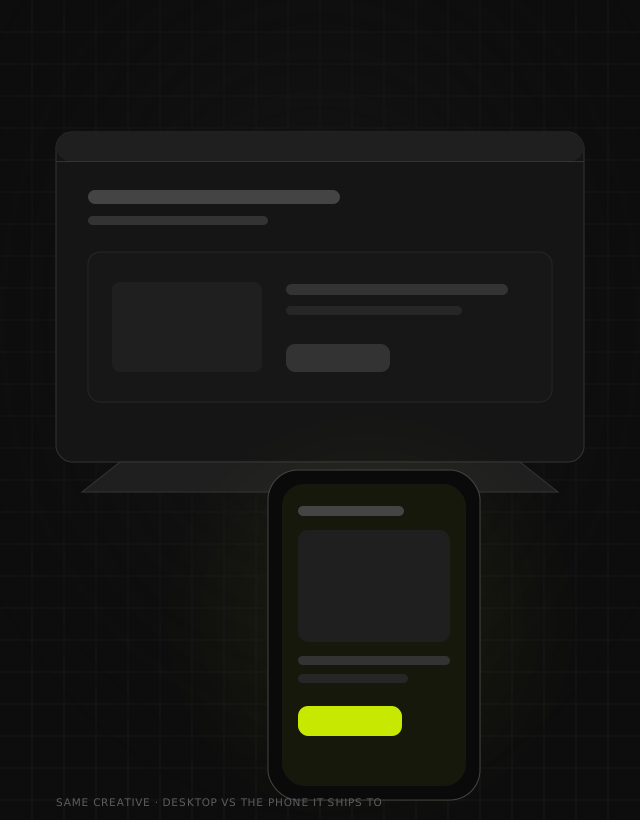
Retail and travel price by geography and by device. The figure returned to a desktop request from a cloud region is rarely the figure a shopper sees on their phone in that country, and the second one is the one you needed.
The failure is quiet
Retail sites rarely block a datacentre range outright. They serve a cached, default or non-personalised page instead. Nothing errors, so the job looks healthy while the numbers drift away from what a shopper sees.
The same handset every run
A device you own stays on one SIM and one carrier. Runs are comparable to each other across weeks because nothing underneath them was swapped out by a pool operator between Tuesday and Thursday.
Throughput when it matters
Turbo mode sends the request over the SIM and takes the response back over WiFi, roughly four times the throughput at half the cellular data. Deep category sweeps stop being the thing that gets cut.
The bill ignores the crawl
Per device per month, unlimited bandwidth. At ten to fifteen dollars per gigabyte the crawl schedule is set by finance. Flat per device, it is set by how often prices actually move.
Four more the same mechanism covers
Same private carrier IP. Different reason for needing one.
Account operations with SMS
Running your own handful of seller, brand or storefront accounts, where each one needs to sign in from somewhere consistent.
A shared pool hands you an address that a hundred strangers used this morning, in a city you have never logged in from. That inconsistency is exactly the signal these platforms score against.
One device per account gives that account a stable carrier IP with a history of its own. When a login asks for a code, a webhook forwards it to your tooling the moment it lands, so verification is a step in the script rather than someone fetching a phone from a drawer.
QA and mobile app testing
Running the test suite over the networks your users are actually on, per carrier and per market.
Carrier networks do things office WiFi does not: carrier grade NAT, IPv6 only stacks, header rewriting, transparent caches, latency that only shows up at the edge. A datacentre proxy reproduces none of it, because a datacentre is not a carrier.
Pair a phone to each carrier you support and point the runner at that device's SOCKS5 port. Battery, success rate and live connection telemetry sit in the dashboard, so a flaky run gets blamed on the right thing.
Market research and SERP checks
Reading search results, app store rankings and marketplace listings the way a phone in that market reads them.
Ranking is mobile first and mobile specific. A datacentre IP gets the desktop shaped answer plus a captcha budget, and a residential pool gets whatever the last tenant earned on that address.
A carrier IP gets the result your customers get. Proxy auth and multiple endpoints per device keep one researcher's runs separate from another's, and rotation keeps a long sweep from reading as a single session.
Localised content checks
Confirming that catalogues, pricing pages, availability and regional banners render correctly in each market you sell in.
Geo decisions are made on the exit address. A cloud region that claims to be nearby is still a cloud region, and pool operators reassign country tags faster than you can audit them.
The device sits on a SIM from the market you are checking, so the check runs from inside that market on that market's own carrier. Gateway domain rules keep the crawler on the properties you meant to check.
Three ways to get an IP
Every workload above turns on the same choice. This is the whole of it.
| Datacentre pool | Residential pool | A phone you own | |
|---|---|---|---|
| Where it exits | A cloud region | Someone else's home line | The phone's own carrier |
| Who else is on it | Everyone on the range | Whoever the pool rents it to next | You, and nobody else |
| How it is billed | Per gigabyte, ten to fifteen dollars is common | Per gigabyte | Per device per month, unlimited bandwidth |
| Rotation control | Whatever the pool exposes | Whatever the pool exposes | Manual, on a timer, or by API call |
| Access rules | Set by the provider | Set by the provider | Your allowlists, denylists and domain rules, enforced at the gateway |
| What a site sees | A server | A home broadband line | A phone on a mobile network |
What it is not for.
Every workload on this page is somebody checking, testing or measuring something they have a right to check. Proxy Farms is not for bulk account creation, credential stuffing, getting into accounts you do not own, spam, fraud, or pulling data from behind a login that was never granted to you. Those accounts get closed. The full list is short and written in plain language.
Read the acceptable use policyPick the workload, pair one phone.
Free 7-day Farm Plan trial, no credit card. One device is enough to find out whether the numbers change.